Advisory 05 · Withdrawal failure
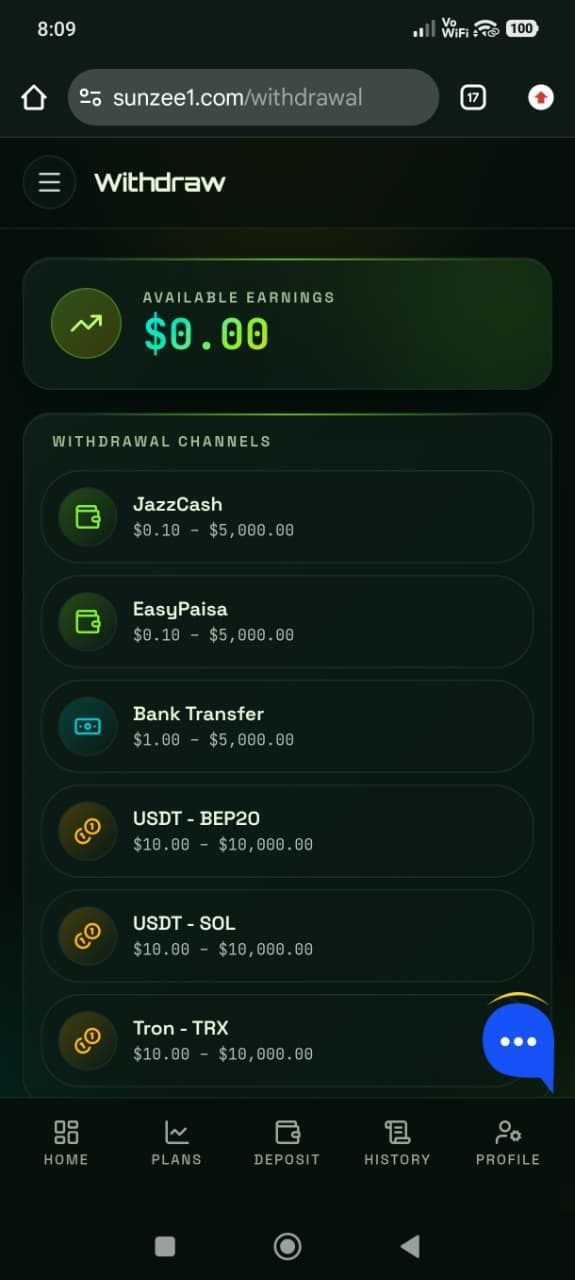
Sunzee1 withdrawal problems
If your withdrawal is pending, frozen, or blocked behind a fee you are being asked to pay first, this page describes exactly what is happening and what to do in the next few hours. Do not pay the fee.
If you are being asked to pay to release your funds — stop
Do not pay it. Not the tax, not the fee, not the VIP upgrade, not the "minimum balance top-up", not the verification charge. No amount of additional payment releases the balance, because the balance is a number in a database rather than funds being held. Every rupee sent from this point is added to the loss. Go straight to the reporting guide.
The sequence, in order
Withdrawal failure on platforms of this type is not random and it is not a technical fault. It follows a sequence so consistent that regulators publish it as a formal warning pattern. Reading it laid out is often the moment things click.
| Stage | What happens | What it is for |
|---|---|---|
| 1 | Small withdrawals process quickly and reliably | Establishes credibility at minimal cost |
| 2 | Dashboard shows strong, steady returns | Encourages larger deposits and reinvestment |
| 3 | Bonuses, limited-time plans, deadline pressure | Accelerates deposits before doubt sets in |
| 4 | Large withdrawal request enters "pending" or "processing" | Buys time; tests whether you will accept delay |
| 5 | A fee, tax, or verification payment is required to release | Extracts a final payment from a committed victim |
| 6 | Fee paid; a second requirement appears | Repeats while the victim still has funds |
| 7 | Account restricted, support silent, or site offline | Exit |
The Internet Crime Complaint Center describes stages one through five in almost these words. Its investment fraud page states that early on, operators commonly allow victims to withdraw both deposits and earnings as a deliberate reassurance, and that when the victim eventually tries to withdraw everything, the account is frozen and an arbitrary requirement appears, usually a demand to pay taxes or fees to unlock the funds. It notes that this is a particularly devastating point, because victims often pay out more in these unlock fees than they ever deposited in the first place.
Why paying the fee never works
People pay it. Intelligent, careful people pay it, and it is worth understanding why rather than judging it.
By the time the fee is demanded, the sum on the dashboard is large and feels real. The fee is small relative to it — five per cent to release ninety-five. Framed that way it looks like an obviously rational transaction, and the alternative feels like walking away from money you have already earned. This is the sunk cost trap operating exactly as designed, and the fee amount is calibrated to sit just below the threshold at which people stop and reconsider.
But the transaction being offered does not exist. There is no pot of funds sitting behind an administrative gate. The number on your screen was written by the operator and represents nothing held anywhere. Paying to unlock it is paying for the release of something that was never deposited into existence.
And the fee is never the last one. Once paid, a second requirement arrives — a compliance charge, a currency conversion, an insurance deposit, an anti-money-laundering hold. The requirements continue as long as the victim continues paying. The only action that ends the loss is stopping, and stopping is available at any point.
Roman Urdu · Agar withdrawal ruk gayi hai
Fees, tax, ya "unlock charge" kabhi na bharein. Yeh paisa aapki withdrawal khol nahi ta — yeh sirf nuqsan barha ta hai. Dashboard par jo balance nazar aa raha hai woh unke computer mein likha hua number hai, kahin rakha hua paisa nahi.
Ek fee bharne ke baad doosri aa jati hai, phir teesri. Yeh silsila tab tak chalta hai jab tak aap dena band nahi karte. Abhi rok dein, screenshots mehfooz karein, aur NCCIA (helpline 1991) mein shikayat darj karayein.
What to do in the first 24 hours
Order matters here. Evidence first, because access can be removed without warning and everything else depends on having it.
- Screenshot everything, now. Balance, transaction history, plan details, the pending withdrawal, every support message, the fee demand itself, and the group or channel where you were recruited. Include the visible date and URL in each capture.
- Copy every transaction hash. Each deposit has a TXID in your wallet or exchange history. These are permanent public blockchain records and they are the strongest evidence in your file. Save the destination addresses too.
- Withdraw whatever the platform will still release. If small withdrawals are still processing, take what you can immediately rather than waiting for the large one to clear.
- Stop all payments. No fees, no top-ups, no "one final deposit to reach the tier". The loss stops the moment you stop paying.
- Secure reused passwords. Email first, then financial accounts, then everything else. Enable two-factor authentication on email.
- File the complaint. NCCIA portal or helpline 1991. The reporting guide sets out exactly what to include.
- Warn the people you recruited. If you shared a referral link, tell them today. This is the highest-value thing available to you and it stops the chain.
The second scam targets you next
Shortly after a loss becomes public, victims are contacted by "recovery experts", "blockchain forensics" firms, fake lawyers and people posing as officials, offering to retrieve the money for an advance fee. These operations specifically target people known to have already lost money — victim lists circulate and are sold. Nobody who contacts you unprompted can recover your funds. Do not pay them, and do not send them ID documents.
What recovery realistically looks like
An honest answer, because false hope causes its own damage.
Crypto sent to an unknown wallet is very rarely recovered by an individual victim. The realistic path to any recovery runs through law enforcement seizing funds at an exchange during an investigation, which requires the operator to be identified, the funds to still be traceable, and the case to be prosecuted. That happens — NCCIA has made significant arrests in online investment fraud cases — but it is slow and it is not the common outcome.
Report anyway, and report even if the amount feels too small to matter. Complaint volume is what establishes a pattern, and a pattern is what turns individual reports into an investigation. Pakistan's National Assembly was told that NCCIA received 77,023 cybercrime complaints in the first five months of 2026, producing 8,048 inquiries, 457 registered cases and 520 arrests. Cases are built out of complaints. Yours contributes to the file whether or not it recovers your own money, and it may be what protects the next person.
The other reason to report is simpler. Being defrauded is isolating, and people frequently stay silent out of embarrassment. It is worth saying clearly: this happens to careful people. The schemes are professionally built, socially validated by people you trust, and specifically engineered to defeat ordinary caution. Falling for one is not a verdict on your intelligence.
Questions people ask
My withdrawal has said "processing" for four days. Is that normal?
On a regulated platform, no. On a platform of this structure, a stall following a large request is stage four of a recognised sequence. Preserve your evidence now, while you still have access.
They say I must pay tax before release. Is that a real requirement?
No. No legitimate platform requires you to send money in order to receive money, and no tax authority collects through a platform's support chat. This is the recognised final stage.
Small withdrawals still work. Should I be worried?
Take what you can now and stop depositing. Small withdrawals continuing to clear is consistent with the model rather than reassuring against it.
Is it worth reporting a small loss?
Yes. Investigations are built from volume. Your complaint may be the one that establishes a pattern, and it costs you nothing but the time to file it.
Someone offered to recover my funds for a percentage. Is that legitimate?
No. Advance-fee recovery scams are the standard follow-on targeting victims of investment fraud. Anyone contacting you unprompted about your loss learned about it because victim lists are traded.