Advisory 04 · Funding and payment rails
Before you deposit into Sunzee1
Sunzee1 takes money in Bitcoin, Ethereum, USDT on Tron and BSC, and Solana. That single design choice tells you more about your legal position than anything on the platform's homepage.
We do not take payments and we do not link to any
sunzee1.app hosts no deposit page, no wallet address and no download button. If you find a site claiming to be a Sunzee1 deposit portal that is not the platform's own domain, treat the wallet address on it as belonging to a third party entirely.
The payment method is the disclosure
Investment platforms tell you the most about themselves in the part of the site nobody reads carefully: the funding options. Here are Sunzee1's actual deposit and withdrawal screens.
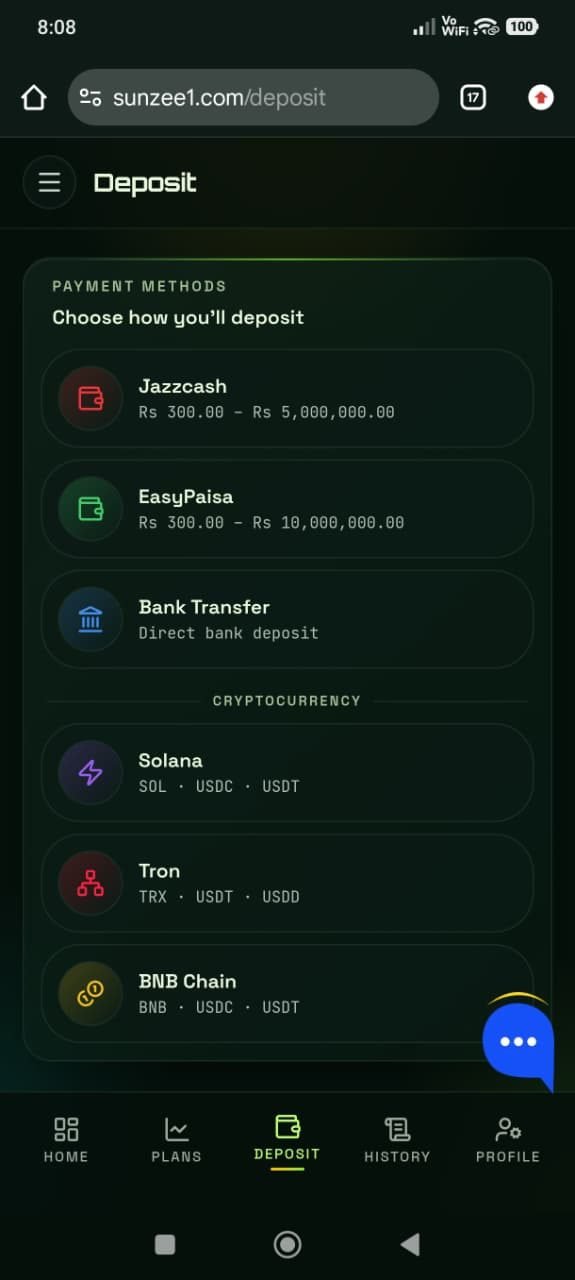
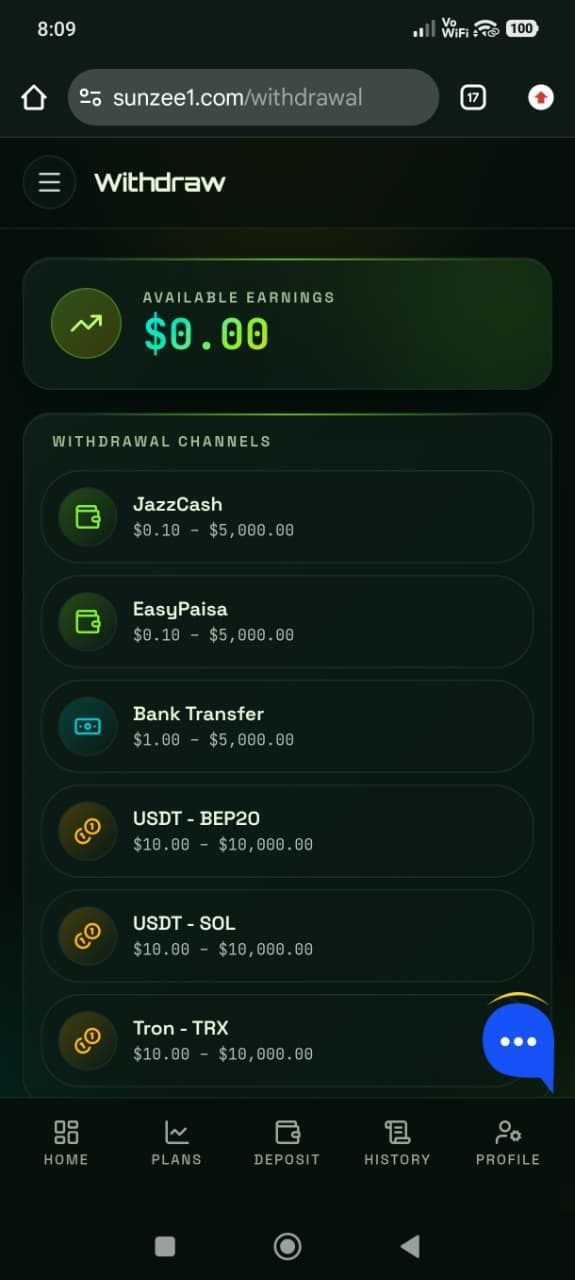
Ask why any of this is shaped this way. A genuine independent power producer selling electricity to utilities under long-term contracts operates entirely through the banking system. It has corporate accounts, receives PPA settlements by wire, pays contractors, files tax returns, and undergoes audits. Retail investment in such an entity, wherever it is regulated, arrives by bank transfer, because that is what regulation requires and what auditors can trace.
Ask why. A genuine independent power producer selling electricity to utilities under long-term contracts operates entirely through the banking system. It has corporate accounts, receives PPA settlements by wire, pays contractors, files tax returns, and undergoes audits. Retail investment in such an entity, wherever it is regulated, arrives by bank transfer, because that is what regulation requires and what auditors can trace.
Crypto rails do the opposite of all of that, deliberately. They require no bank relationship, no compliance department, no identity verification the operator does not choose to run, and above all they are irreversible. When a platform selects them as the primary funding method for what it describes as an infrastructure business, it is not choosing convenience. It is choosing finality.
Recourse after payment WHAT YOU CAN UNDO
Once a crypto transaction confirms, there is no institution anywhere with the power to reverse it. Not the network, not your exchange, not a court, not the police. The transaction is permanently recorded and permanently final. This is a feature of the technology, not a failure of it — but it means the decision to send is the only decision you get to make.
What "irreversible" means in practice
People underestimate this because they have never needed to reverse a payment before. It is worth being concrete.
If you pay a fraudulent merchant by card, your bank has a chargeback process, a regulator supervising it, and a legal obligation to investigate. If you send a bank transfer in error, there is a recall procedure and a paper trail connecting a named account holder to a verified identity. Neither mechanism is perfect, but both exist, and both put an institution between you and the loss.
If you send USDT to a TRC-20 address, the transaction is broadcast, confirmed within seconds, and permanently recorded. The recipient is a string of characters with no name attached. There is no support line, no dispute form and no reversal function. The funds can be moved through mixers or across chains within minutes. Law enforcement can sometimes trace them and occasionally seize them at an exchange, but the realistic recovery rate for retail victims is very low.
This is exactly the mechanism the FBI's Internet Crime Complaint Center describes in its investment fraud guidance: it notes that by the point a victim realises what has happened, the operators have typically already moved the funds into criminally controlled wallets that the victim cannot reach, and the victim loses everything deposited.
The Pakistan regulatory picture
The regulatory position on crypto in Pakistan has moved quickly and is worth understanding accurately rather than in slogans. The State Bank of Pakistan directed banks and payment institutions in 2018 not to process virtual-currency transactions, and reiterated for years that virtual currencies are not legal tender and that it has licensed no entity to deal in them. More recently the government created the Pakistan Crypto Council and, under the Virtual Assets Ordinance 2025, the Pakistan Virtual Assets Regulatory Authority (PVARA) to build a formal licensing regime. The framework is still being assembled.
What that means for you is simple, and it does not depend on how the crypto debate resolves. Whatever the status of a coin, a scheme that collects public investment and promises returns needs authorisation as an investment business — and that authority in Pakistan is the Securities and Exchange Commission of Pakistan, not a crypto rule. A platform can route its money through USDT and still be an unlicensed investment scheme. The payment rail and the investment licence are two separate questions, and Sunzee1 gives an unsatisfactory answer to both: irreversible rails on one side, no identifiable SECP-authorised entity on the other.
Roman Urdu · Yaad rakhein
Crypto bhejne ke baad wapsi ka koi rasta nahi hai. Bank transfer ya card mein bank se shikayat ho sakti hai. USDT (TRC-20/BEP-20) confirm hone ke baad na network, na exchange, na police usay wapas kar sakti hai.
Isi liye yeh log crypto maangte hain. Yeh aasani ke liye nahi — yeh is liye hai ke aap paisa wapas na le sakein. Bhejne ka faisla hi aakhri faisla hota hai.
The plan structure and what it is really measuring
Platforms of this shape present tiered plans: a minimum deposit, a stated daily or hourly percentage, a term length, and capital returned at the end. Higher tiers pay higher percentages. Sunzee1 states that plan terms vary, that earnings can be withdrawn at any time, and that the invested amount returns when the plan ends.
Two things are worth noticing in that structure.
First, the tiering. There is no legitimate business reason why a solar farm would pay a larger percentage of revenue per rupee to a bigger investor than a smaller one. Generation revenue is generation revenue; a share is a share. Tiering exists for a behavioural reason — to pull each depositor upward — and it is a near-universal marker of the model. Real infrastructure funds pay lower percentage returns at higher volume, not higher, because scale reduces risk premium.
Second, the promise that capital returns at the end of the term. This is what converts a deposit into what feels like a fixed-term saving. But it also means your principal is locked for the plan duration, and the platform's obligation to return it sits furthest in the future, where it costs nothing today. In schemes of this shape, the end-of-term capital return is the promise most frequently unmet, because it is the largest liability and the one that arrives last.
Five questions to answer before sending anything
These are not specific to Sunzee1. Run them on any platform asking for money, and run them before the deposit rather than after.
- Who is the legal entity, and where is it registered?A company name, a registration number, a jurisdiction, a physical address, named directors. If you cannot find all five, you have no counterparty. You are not investing; you are donating with an expectation.
- Which regulator authorises this, and can I confirm it on the regulator's own site?Not on the platform's site — a claimed licence number means nothing until it appears in the regulator's public register. In Pakistan, check the SECP.
- Where does the money to pay me come from, specifically?Not "solar", not "trading", not "AI". Which customer pays which invoice? If the honest answer is "from deposits by people who join after me", you have your answer.
- Why does it need retail money at all?An asset returning what is claimed here would be funded instantly by institutions on far better terms. Ask why it is being offered to you.
- Can I afford to lose all of it, permanently, starting today?Not "would it hurt". Can rent be paid, can the family eat, can the loan be serviced. If the honest answer is no, then the size of the potential return is not the relevant number.
Never borrow to deposit
This is the single most damaging pattern in this whole category. Committee money, a gold loan, a credit card advance, a friend's savings, money borrowed against a shop or a plot — when a scheme funded this way stops paying, the loss does not end at the deposit. The debt survives it. People who deposit borrowed money are the ones whose lives are still damaged three years later.
Questions people ask
Can I get a USDT deposit back if the platform stops paying?
Almost certainly not. Confirmed crypto transactions cannot be reversed by anyone. Report it regardless — reports build the case files that produce arrests and warn others — but plan on the basis that the money is gone.
Is a small test deposit a sensible way to check?
It tests nothing that matters. Small deposits are designed to be paid out, precisely so that you conclude the platform works and deposit more. The test does not fail until the amount is large enough to hurt.
The site says it accepts fiat too. Does that make it safer?
Only if the fiat route goes to a named, regulated company account you can verify. If it routes through a personal account, an agent, a P2P trader or a payment app, it carries the same finality as crypto with an extra intermediary.
What if my friend's deposits are all paying out fine?
Early participants being paid is how the model functions, not evidence against it. Their returns are funded by later deposits, and the later deposits eventually include yours.