Sunzee1 review 2026: real or fake?
Sunzee1 says it owns solar farms on four continents and pays you a share of the electricity revenue every hour. We checked that story against how solar power plants and investment regulation actually work. It does not hold together.
What Sunzee1 claims to be
According to its own website, Sunzee1 is a solar energy investment platform. The pitch is unusually specific, which is part of what makes it persuasive. Its homepage describes co-owned solar arrays in Nevada, Andalusia and Rajasthan, monocrystalline cells feeding grid-tied inverters and lithium-iron storage banks, and electricity sold to utility companies under long-term power purchase agreements. Members are told their profit is a share of that revenue, paid hourly, and that a live dashboard shows kilowatt-hours generated, plant health and even panel temperature.
Deposits are accepted in Bitcoin, Ethereum, USDT on Tron and BSC, and Solana. The site says more than twelve thousand members are already earning. Invested capital, it says, is returned at the end of the plan term, and earnings can be withdrawn at any time.
Read that back slowly. Every sentence in it is engineered to answer an objection before you raise it. Worried the sun sets? The grid spans time zones. Worried it's fake? Here's a live data feed. Worried about your capital? You get it back at the end. This is not how a real energy company writes; it is how a sales funnel writes.
The number that does not work
You do not need to be an energy analyst to test this. You only need one figure: what a real solar power plant earns. And helpfully, the platform states its own figure openly on its plans screen.
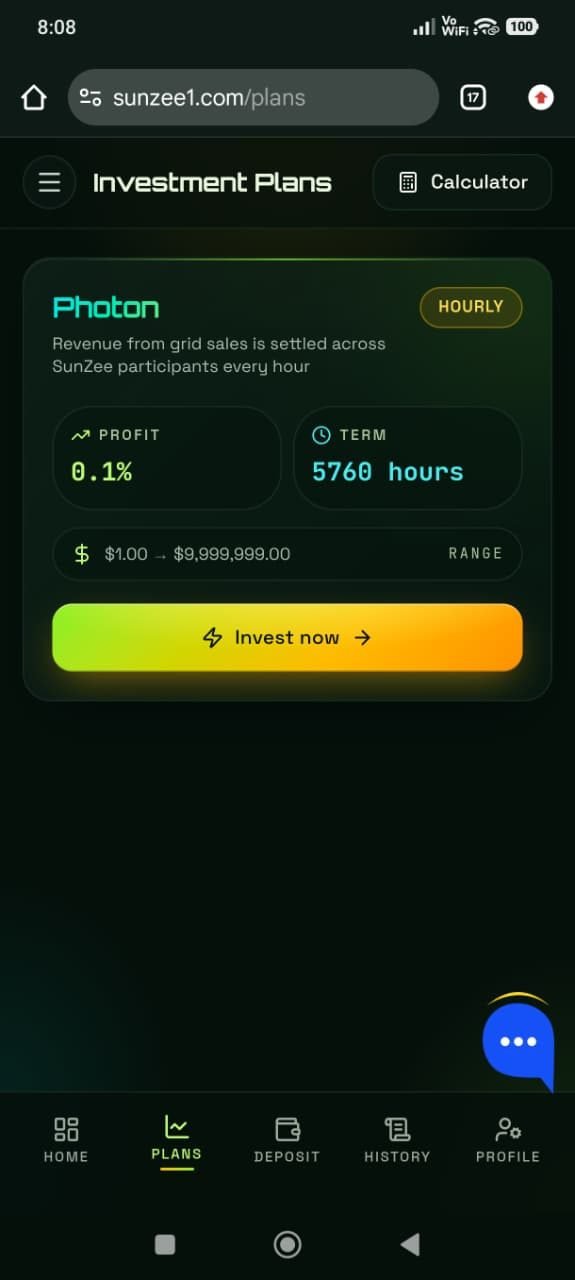
Utility-scale solar is a well-documented asset class. It is capital-intensive, heavily financed, and its returns are famously stable and famously modest. A well-run solar farm under a long-term power purchase agreement typically produces an unlevered return in the range of roughly five to twelve per cent per year, before financing costs, land costs, insurance, inverter replacement, grid fees, curtailment losses and degradation of about half a per cent annually. That is the number that makes solar attractive to pension funds: it is boring, predictable and small.
Reality meter · annual yield SCALE: 0–400%
A platform promising even 1% per day is claiming to beat the underlying asset by a factor of roughly thirty. The gap is not efficiency, technology or scale. There is no solar innovation that turns a 9% asset into a 300% one. The gap is the deposits of the people who joined after you.
So when a platform offers a fixed daily or hourly percentage from solar generation, the arithmetic is doing something the panels cannot. If Sunzee1's arrays genuinely produced returns of that magnitude, no retail investor would ever be offered them. Sovereign wealth funds, infrastructure banks and utilities would be queuing to buy the whole operation at a valuation that made public fundraising pointless. The single most reliable signal in finance is this: genuinely high-return, low-risk opportunities are never advertised to strangers on the internet. They are absorbed privately, long before you hear the name.
Roman Urdu · Asaan tarjuma
Sadi baat yeh hai: asli solar power plant saal bhar mein taqreeban 5 se 12 percent munafa deta hai. Jo platform aap ko roz ka ya ghantay ka fixed profit de raha ho, woh solar se nahi de raha — woh naye logon ke deposits se de raha hai.
Jab naye log aana band ho jate hain, withdrawal rukna shuru ho jati hai. Yeh koi ittefaq nahi, yeh is model ka lazmi anjaam hai.
Six structural problems
- The assets cannot be verifiedNevada, Andalusia and Rajasthan are regions, not addresses. A real independent power producer publishes plant names, capacity in megawatts, commissioning dates, grid interconnection references and the name of the offtaker on the power purchase agreement. Sunzee1 names none of these. You cannot check what you cannot locate.
- Power purchase agreements do not work that wayPPAs are contracts between a generator and a utility or corporate buyer, settled monthly or quarterly against metered delivery, with credit terms, curtailment clauses and penalties. No independent power producer on earth distributes PPA revenue to thousands of anonymous retail members on an hourly basis. The operational cost alone would exceed the revenue.
- The dashboard is not evidenceA live feed showing kWh, plant health and panel temperature is impressive and completely unverifiable. Those are numbers on a screen, generated by the same people asking for your money. Nothing on the dashboard is audited, and nothing connects it to a real meter you could independently check. Fabricating a convincing telemetry display is an afternoon of front-end work.
- Crypto-only deposits remove every protectionReal regulated investments accept bank transfers precisely because banks create records, reversibility and accountability. USDT on Tron or BSC is final, pseudonymous and irreversible. Once sent, there is no chargeback, no dispute process and no intermediary with an obligation to you. That is the point of using it. We cover this in detail on the deposit page.
- Returns are guaranteed, which is legally impossibleReal energy revenue varies with irradiance, season, weather, grid demand, spot pricing and outages. A December week in Nevada is not a June week. Any platform paying a flat rate regardless of these variables is not passing through generation revenue — it is paying from a pool, and that pool has one source.
- Income depends on recruitmentSearch "Sunzee1 review" and count how many results are videos with a referral link in the description. That is not organic interest; it is a commission structure at work. When the people reviewing a product are paid to enrol you in it, the reviews are advertisements. This site carries no referral link, which is the only reason you should give any weight to what you are reading here.
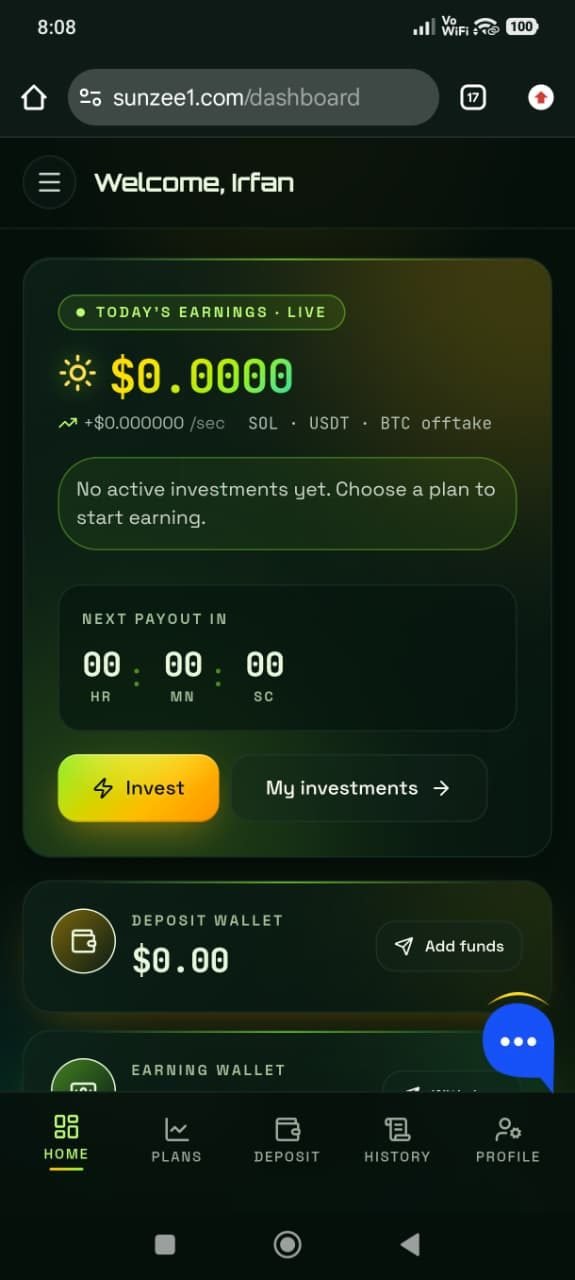
Two of those points are visible directly in the app's own screens, so there is no need to take our word for either.
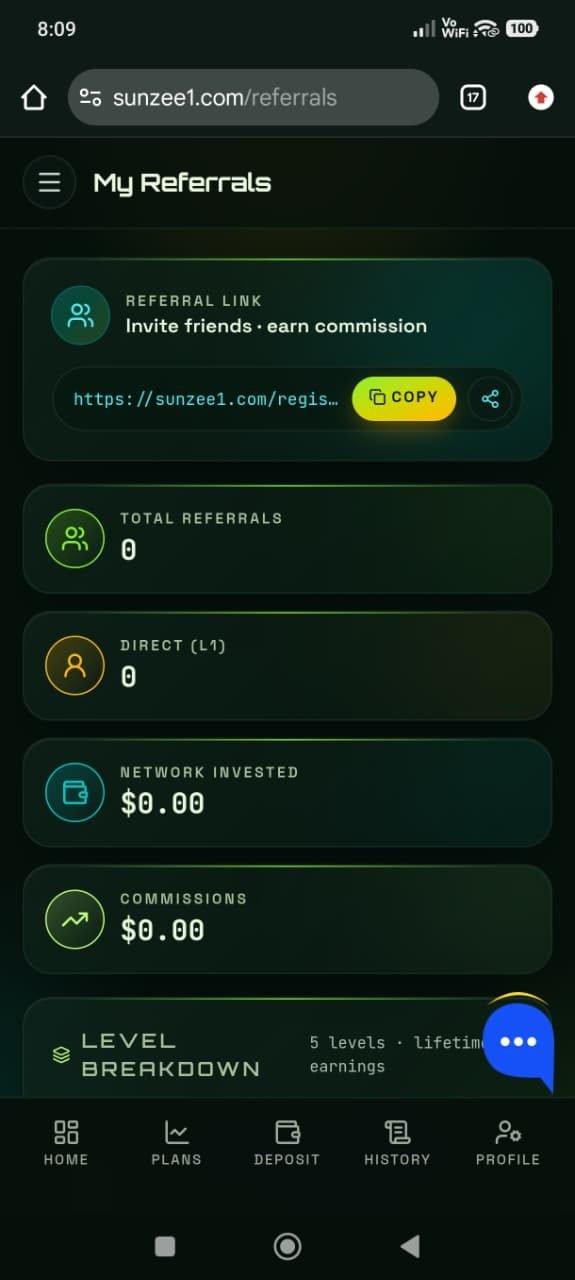
That referral screen is the most honest page on the platform. A genuine solar operator selling electricity to utilities has no reason to pay you five levels deep for enrolling strangers. A structure that must pay members to recruit members is telling you where its money comes from.
Why small withdrawals succeeding proves nothing
The most common message received by advisory sites like this one is a version of: "But I withdrew 2,000 rupees and it arrived, so it must be real."
It arrived because it was supposed to arrive. The US Federal Bureau of Investigation's own guidance on investment fraud describes this mechanism explicitly. The Internet Crime Complaint Center notes that it is common early on for the operators to let victims withdraw both their original deposit and the earnings — a deliberate reassurance that the platform is genuine. The pot is then sweetened with limited-time offers and other pressure to invest more. When a victim finally tries to withdraw everything, the account is frozen and a new requirement appears, usually a "tax" or "fee" that must be paid before funds are released.
A small successful withdrawal is not evidence of solvency. It is the cheapest marketing expense the operator has. Two thousand rupees paid out today can produce fifty thousand deposited tomorrow, plus a testimonial video with a referral link. You are not being paid a return; you are being bought as a salesperson.
If the withdrawal freezes, stop
If you are ever told you must pay a fee, tax, "unlock charge", VIP upgrade or minimum-balance top-up before your withdrawal can be released — do not pay it. That request is the confirmation, not the obstacle. Money paid at this stage is money added to the loss, never money that recovers it. More on the withdrawal pattern.
The legal position in Pakistan
Anyone soliciting investment from the public in Pakistan needs authorisation from the Securities and Exchange Commission of Pakistan. We found no evidence of any such registration for this platform, and no company registration, physical office, named directors or audited accounts. An unlicensed scheme collecting public funds and paying returns from new deposits falls within the definition of fraud under the Prevention of Electronic Crimes Act 2016.
This matters for a second reason that many people miss. If you promote such a scheme — sharing a referral link, running a WhatsApp group, posting a review video with your code — you are not simply a bystander. Recruiters have been prosecuted alongside operators. In July 2025 the National Cyber Crime Investigation Agency raided a facility in Faisalabad and arrested 149 people over a large-scale online fraud operation involving Ponzi schemes and investment scams. The people arrested in these operations are frequently mid-level promoters, not the founders, who are usually offshore and unreachable.
What we could not determine
Honesty cuts both ways, so here is what this review does not establish. We have not proven that Sunzee1 has stolen anyone's money. We have not accessed its books, because there are none published. We cannot say when or whether it will stop paying. It is possible that some members will withdraw more than they put in — in a scheme of this shape, the early participants usually do, funded by the later ones.
What we can say with confidence is that the described business model cannot generate the returns advertised, that the operator is anonymous and unregulated, that funds move by irreversible crypto rails, and that growth depends on recruitment. Those four facts are enough. You do not need to wait for a collapse to recognise a structure that only ends one way.
Questions people ask
Is Sunzee1 real or fake?
The website is real and it functions. The business behind it — solar plants generating the advertised returns — is not evidenced by anything verifiable. Treat "the site works" and "the investment is genuine" as two completely separate questions.
My friend has been withdrawing for weeks. Isn't that proof?
No. Early participants withdrawing successfully is a feature of this model, not a contradiction of it. Their payouts come from later deposits. Ask your friend again in three months, or when they attempt a large withdrawal.
Is it safe if I only invest a small amount?
Smaller loss, same probability. But be aware that the design pulls in the other direction: a small deposit that pays out is intended to produce a larger one. Very few people who lose money in these schemes lost it on their first deposit.
Can I get my money back?
Crypto transfers are irreversible, so recovery is difficult and often impossible. Report it anyway — reports create the case files that lead to arrests, and they protect other people. Anyone who contacts you promising to recover your funds for an upfront fee is running a second scam on the victims of the first. See the reporting guide.
Why should I trust this website?
Don't trust it — check it. Every claim here is either arithmetic you can verify yourself or a link to a regulator's own guidance. What should raise your confidence slightly is what is absent: no referral link, no download button, no signup form, nothing to sell you. We have no financial interest in your decision either way.