Safety guide · Use on any platform
The 8-point safety check
This checklist is not about Sunzee1. It is about the next one, and the one after that. Eight questions, five minutes, and you will correctly classify almost any earning platform you are ever shown.
Every few months a new earning app arrives with a new story. Solar farms. AI trading bots. Crypto arbitrage. Cloud mining. Product-review tasks. Livestock investment. Warehouse logistics. The narrative changes constantly because the narrative is the disposable part — it exists to be interesting, and it gets replaced when the previous one is burned.
The structure underneath does not change. Learn to read the structure and the story becomes irrelevant. That is what this checklist is for.
1. Can you name the legal entity?
Find a registered company name, a registration number, a jurisdiction, a physical address and at least one named director. Then verify at least one of those independently, on a government register rather than on the platform's own site.
If you cannot complete this step, you can stop here — the remaining seven questions are optional. An investment where you cannot identify the counterparty is not an investment. There is no one to sue, no one to complain about, no one to serve papers on, and no name for police to investigate. Anonymity is not an oversight in these operations; it is the core operational requirement.
Watch for the counterfeits: a "certificate of incorporation" image on the homepage that belongs to a dissolved shell company, a company registered in a jurisdiction that sells registrations for a hundred dollars, or an address that resolves to a virtual office or a residential flat.
2. Which regulator authorises it — and does the regulator agree?
Any entity collecting investment from the public needs authorisation. In Pakistan that is the Securities and Exchange Commission of Pakistan. Elsewhere it is the FCA, the SEC, ASIC, or an equivalent body.
The critical detail: verify on the regulator's own register, not on the platform's website. A licence number printed on a homepage is a string of characters that anyone can type. Fraudulent platforms routinely display real licence numbers belonging to entirely different, legitimate companies, betting that nobody will check. Checking takes ninety seconds on a public register.
3. Does the return survive contact with arithmetic?
This is the question that resolves most cases on its own.
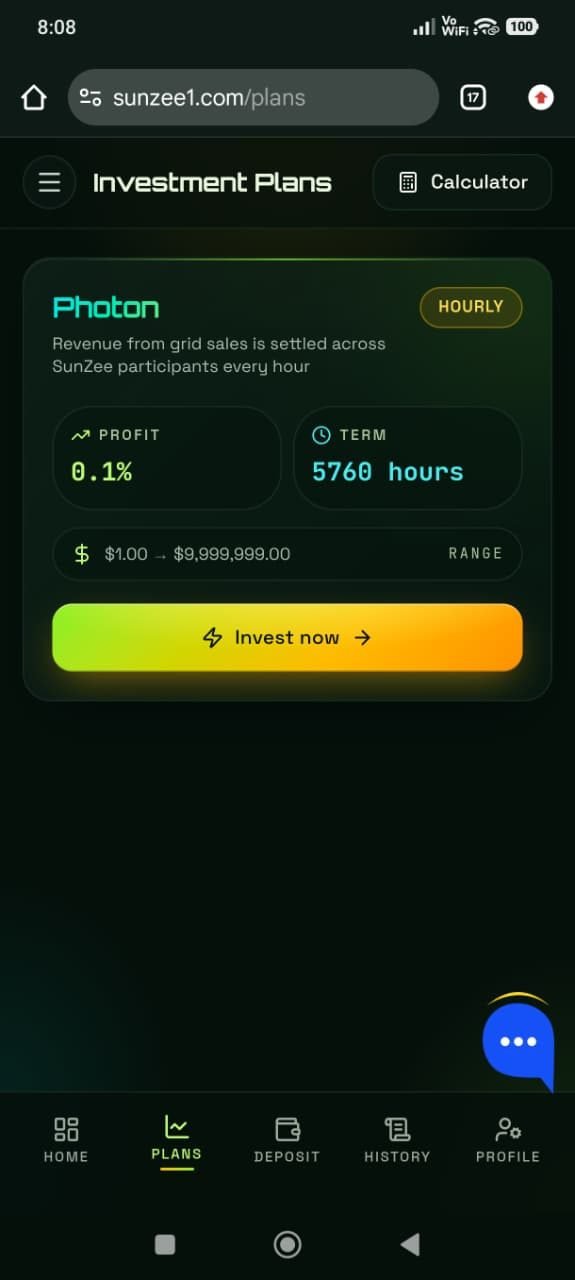
Identify the claimed return, then convert it to an annual figure. One per cent per day is not "about 365 per cent a year" — compounded, it is over three thousand per cent. Then compare that against what the underlying asset actually produces.
| Asset class | Realistic long-run return |
|---|---|
| Bank deposit / savings | Low single digits above inflation, at best |
| Government bonds | Modest, roughly tracking policy rates |
| Utility-scale solar under PPA | Roughly 5–12% per year, unlevered |
| Broad stock market, long run | Historically around 7–10% per year, with real losses in bad years |
| Elite hedge funds, best decades | 20–30% per year, and considered extraordinary |
| "Guaranteed 1% daily" | Not an asset class |
The reference point worth memorising: the most successful investors in recorded history compounded at roughly twenty to thirty per cent per year, over decades, and are studied for it. A platform offering a fixed one per cent per day is claiming to beat them by more than a hundredfold, reliably, with no bad days, while advertising it to strangers on WhatsApp. Nothing about that survives five seconds of arithmetic.
Note also the word "guaranteed". Real returns fluctuate because real revenue fluctuates. A fixed daily rate is not a good investment; it is a signal that the payout is unconnected to any underlying performance.
4. Where does the money to pay you come from?
Ask it specifically, and refuse abstractions. Not "solar", not "trading", not "AI". Which customer pays which invoice, and can you see that revenue documented anywhere?
Then apply the single most useful test in this entire guide:
The one-question test APPLY TO ANY PLATFORM
A bakery survives if nobody new opens an account, because it sells bread. A scheme paying members from members' deposits collapses the moment recruitment slows — which is why every platform of this shape pushes referrals so hard. The pressure to recruit is not a marketing choice. It is a solvency requirement.
5. How does it want to be paid?
Crypto-only funding, particularly USDT on TRC-20 or BEP-20, removes every protection you would otherwise have. Transfers are final on confirmation, the recipient is pseudonymous, and no institution has the power to reverse them.
Also treat as a failure: payment to a personal bank account rather than a company account, payment through an "agent" or a P2P trader, payment via mobile wallet to an individual, or a request for gift cards. Each of these achieves the same thing — severing the traceable link between your money and an accountable entity. More detail on payment rails here.
6. Are you being paid to recruit?
Referral commissions, multi-level structures, team bonuses, "leader" ranks, volume targets on your downline. When your income depends on enrolling others rather than on a product being sold to customers, you are inside a recruitment scheme regardless of the story attached.
The tell that follows from this: search for reviews and see how many carry referral links. If the entire visible discourse about a platform is produced by people paid per sign-up, then there is no independent information about it available to you, and the absence itself is data.
7. Is there time pressure?
Limited slots. Bonus expires in 24 hours. Price rises Monday. Only 50 places at this tier. VIP closing soon.
Urgency exists to prevent research, and nothing else. A legitimate investment opportunity survives your taking a week to think, asking a knowledgeable friend, and reading the terms. The FTC makes this the centrepiece of its guidance: it advises rejecting high-pressure pitches outright, noting that legitimate investments give you all the time you need to investigate before you spend anything.
Treat urgency as a complete answer in itself. You do not need to evaluate the rest of the offer.
8. What are the exit terms — and what have others experienced on exit?
Getting in is always effortless. The whole question is whether you can get out.
Search the platform's name alongside words like "withdrawal problem", "not paying", "pending", "scam" and "complaint" — the FTC recommends exactly this before committing to any programme. Weight what you find carefully: recent complaints matter more than old praise, and complaints about large withdrawals matter far more than praise about small ones, because small payouts are part of the design.
Also read the exit terms themselves. Minimum withdrawal thresholds that keep rising, lock-in periods, mandatory reinvestment, "VIP levels" required before withdrawal, or charges to withdraw are all mechanisms for keeping deposits inside the system.
Roman Urdu · Aath sawal, paanch minute
1. Company ka naam, registration number aur malik ka naam mil raha hai? 2. SECP ki apni website par licence verify hota hai? 3. Jo munafa keh rahe hain, kya woh haqeeqat mein mumkin hai? 4. Paisa aata kahan se hai — agar naye log aana band ho jayen to kya phir bhi de sakenge? 5. Sirf crypto (USDT) maang rahe hain?
6. Kya kamai logon ko join karwane par milti hai? 7. Kya jaldi karwa rahe hain — "sirf aaj tak", "slots khatam"? 8. Bade withdrawal ke baare mein log kya keh rahe hain?
Do sawal bhi fail ho jayen to bas kar dein. Jo cheez sach mein itna munafa deti, woh WhatsApp par ajnabiyon ko na milti — bade investors pehle hi kharid chuke hote.
Two things that look like evidence but are not
Payment proofs. Screenshots of successful withdrawals prove almost nothing. They are trivially edited, and the genuine ones are genuine because early small payouts are part of the model. A wall of payment proofs is a marketing asset, not an audit.
A polished app and dashboard. Slick design, live counters, two-factor authentication and a real-time telemetry feed represent the cheapest part of the operation. Building an impressive front end is a few days of work with free components. It tells you the operator invested in appearance, which is exactly what you would expect either way.
Questions people ask
How many of the eight need to fail before I walk away?
Two is comfortably enough. One is enough if it is question one or question four — an unidentifiable owner or payouts funded by recruitment are each fatal on their own.
What if the platform has been paying reliably for months?
Duration is not solvency. Schemes of this shape are specifically designed to pay reliably until they do not, and the longest-running ones cause the largest losses precisely because the track record recruits more depositors.
Are all crypto or online earning platforms scams?
No. Regulated exchanges and licensed investment products exist and can be verified on public registers. The distinction is not the technology — it is whether there is an identifiable, licensed, accountable entity behind it.
How do I check something the checklist does not cover?
Search the name with "scam", "complaint" and "not paying", check the regulator's register, and ask yourself where the money comes from. Those three cover almost everything the eight questions do.